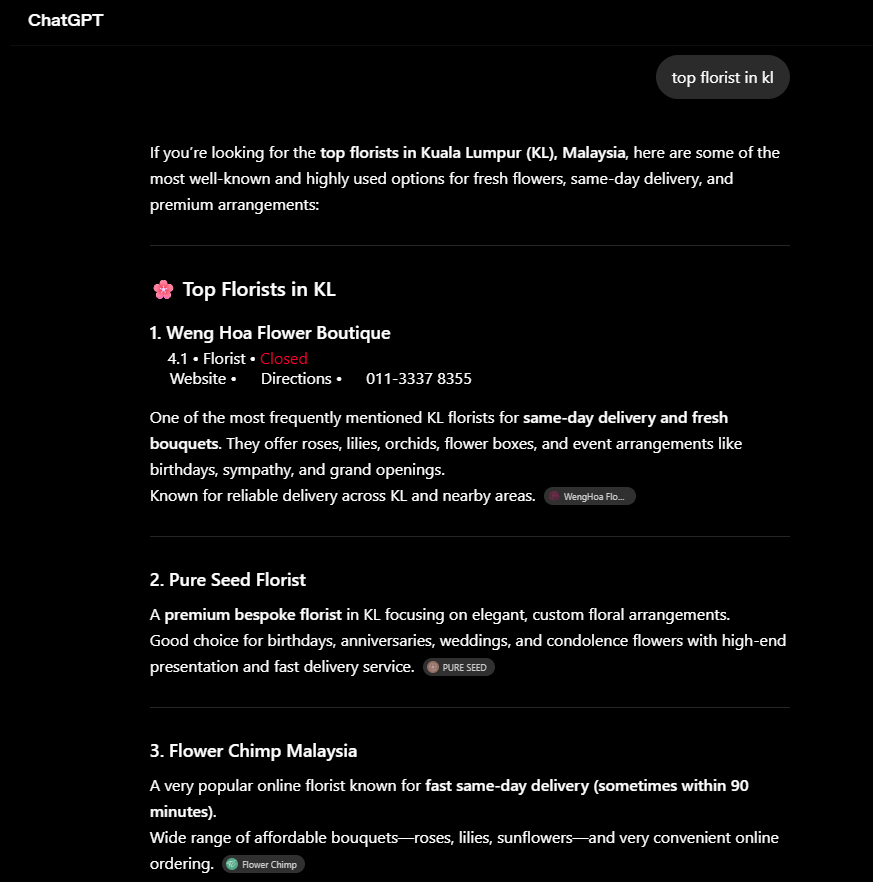
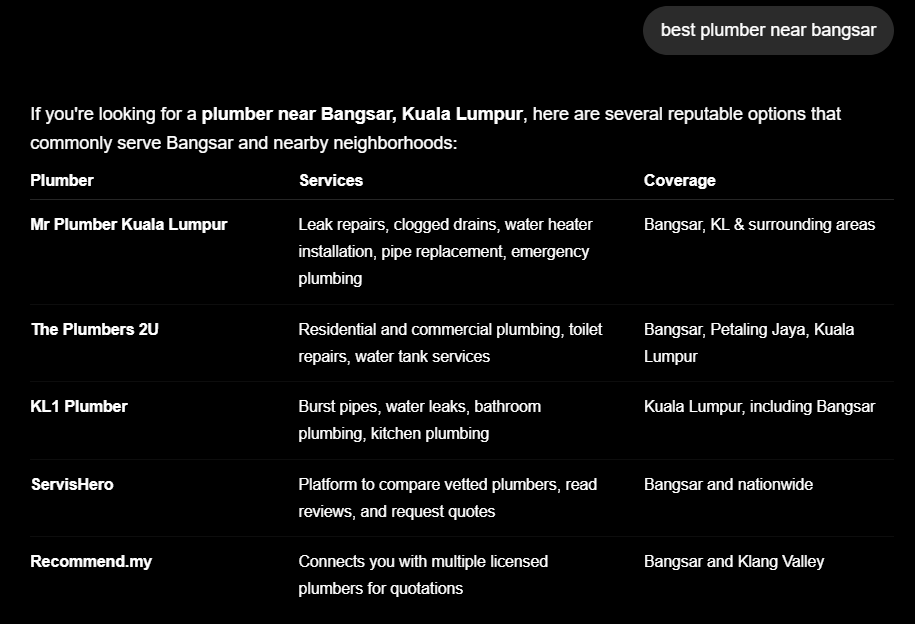
Picture this: a potential customer wants to buy a product or get services from a company like yours. Instead of typing a search into Google, they open ChatGPT and ask, “What’s the best [your industry] company in [your city]?” The AI gives them a confident, well-organized answer — three or four names, a short explanation of what each one does well, maybe a recommendation.
Is your business one of those names? For a growing number of businesses, the honest answer is “we don’t know.” And that uncertainty is quickly becoming a real business problem.
AI Search Is No Longer a Side Trend
A few years ago, asking a chatbot for a recommendation was a novelty. In 2026, it’s a habit. OpenAI reported that ChatGPT crossed 900 million weekly active users by early 2026, and by June 2026, Reuters reported the app had passed 1 billion monthly active users — the fastest any app has ever reached that milestone. That kind of reach changes how people find businesses, on the consumer side and the B2B side alike.
This isn’t limited to ChatGPT. Google’s AI Mode, Perplexity, Gemini, and Microsoft Copilot are all part of the same shift. For a broader look at how these platforms compare to traditional search, see our article on AI search vs. traditional search. But because ChatGPT has the largest user base and the most name recognition among everyday consumers and business buyers alike, it’s the natural place to start checking your own visibility.
Why This Is Different From Ranking on Google
Showing up on page one of Google and showing up in a ChatGPT answer are two different challenges. Traditional search returns a list of links and lets the user choose. AI search tools usually return a short, direct answer which are often just a handful of names, sometimes only one. There’s no “page two” to fall back on. You’re either part of that answer, or you’re not part of the conversation at all.
ChatGPT also doesn’t read your site the way a search engine crawler does. It breaks pages into smaller chunks of text and pulls out whichever piece best answers the question being asked. That means a page that ranks well on Google isn’t automatically a page an AI model will quote back to a user beacuse the content itself has to be easy to lift, and the brand behind it has to be backed up by sources outside your own website. Our piece on what Google AI Mode means for search is a useful next read if you want to go deeper on this shift.
How to Check Your Own AI Visibility
You don’t need special tools to get a first read on where you stand. The steps below move from a quick manual check to a more complete, ongoing picture.
1: Ask ChatGPT the Way a Customer Would
Test like a real customerTry prompts like “Best [your industry] company in [your city],” “Who is [your business name]?,” “[Your business] vs. [a competitor],” or “I need help with [the problem you solve] — who should I use?” Note whether your business appears, whether the details about you are accurate, and which competitors show up instead. It helps to think in terms of a small cluster of related questions rather than a single query, since AI tools tend to reward brands that show up consistently across a topic, not just one lucky phrasing.
2: See Where the Answer Is Coming From
Trace the sources behind the answerWhen ChatGPT names a competitor and not you, ask it directly what it based that answer on. You’ll often see a mix of review platforms, industry roundups, comparison articles, and community discussions rather than a company’s own homepage. That tells you where the real opportunity is: getting included in the third-party sources ChatGPT already trusts, not just polishing your own site.
3: Repeat It — Don’t Trust One Answer
One check is a snapshot, not proofAI responses can vary between sessions and models, so run the same prompts more than once, and try them on other platforms like Gemini or Perplexity too. A single result tells you very little on its own — the pattern across several checks, over several weeks, is what actually matters.
4: Track It Over Time
Move from spot-check to visibilityManual checks only capture a moment in time, so ongoing tracking is what gives you a real trend line — whether you’re gaining ground on a competitor or slowly losing visibility without noticing. Our guide on AI visibility tools and how they measure content impact walks through how that kind of tracking works in practice.
What Influences Whether AI Mentions You
A few factors show up again and again in research on this topic:
- Third-party validation. An analysis by Ahrefs found that a large share of ChatGPT’s most-cited pages come from highly authoritative domains — being mentioned by trusted, independent sources carries real weight, often more than what your own website says about you.
- Reviews and reputation. For “best of” and comparison questions, AI tools frequently draw on platforms like G2, Trustpilot, and Capterra, weighing your rating, the recency of your reviews, and how specific features are described. Weak review coverage compared to competitors can quietly leave you out of the conversation even when your own content is solid.
- Clear, answer-first content. Since AI tools pull out small chunks of a page rather than reading it top to bottom, content that states the answer plainly near the top — supported by headings, short lists, and tables — tends to get lifted more often than a page that buries the point under a long introduction. See how to turn your content into a source AI recommends.
- Technical accessibility. Make sure your robots.txt file isn’t unintentionally blocking AI crawlers, and that key pages load quickly without depending on heavy scripts to display their content — AI bots skip over pages that are slow or hard to read.
- Freshness. Ahrefs’ analysis of roughly 17 million AI citations found that content cited by AI assistants is on average about 25.7% more recent than what shows up in standard Google results. Keeping stats, examples, and FAQs updated is a real, measurable lever here — not just good housekeeping.
- Consistency and citations, not just links. Your business name, location, and description should match wherever they appear, and getting mentioned by name in articles and comparisons matters more here than a traditional backlink. Our article on brand citations and AI SEO explains why.
💡 Pro Tip:
Google Analytics and most standard marketing dashboards don’t show you when an AI tool mentions or omits your brand. You could be losing potential customers at the very first stage of their research and never see a trace of it in your data — which is why this deserves its own tracking, not a footnote in your usual reports.
It’s Early — and That’s Actually an Advantage
It’s worth being upfront: AI search is still new, the platforms are evolving quickly, and no one — including us — can promise a guaranteed spot in every AI-generated answer. Shortcuts like keyword stuffing or old-style link schemes won’t reliably move the needle here either; what tends to hold up is genuinely useful content, real third-party validation, and steady maintenance over time. What the data does show is that AI is clearly becoming part of how people research and choose businesses, and the companies paying attention early are the ones best positioned as the technology matures. This doesn’t replace foundational SEO work either; if anything, the two now work together, as we cover in why investing in SEO still matters.
Ready to Find Out Where You Stand?
Navigating these new visibility signals doesn’t have to be a guessing game. Ematic Solutions’ AI SEO service helps businesses understand where they currently stand in AI search results, identify the gaps holding them back, and build the kind of clear, credible online presence that AI models are more likely to reference. Running a few of the checks above is a good first step — and if you’d like a more thorough look, our team is happy to walk you through what we’re seeing across AI platforms today.
Frequently Asked Questions
How can my brand appear in ChatGPT?
Focus on three things: getting mentioned by name on the third-party sites ChatGPT already cites (review platforms, comparison articles, industry roundups), keeping your own content clear and answer-first so it’s easy to pull into a response, and keeping your business information consistent everywhere it appears online.
How to track brand mentions in ChatGPT?
Start with manual prompt testing — run the same set of questions every week or two and log whether you appear. As you scale, dedicated AI visibility tracking tools can monitor this automatically across many prompts and platforms, which catches shifts that occasional manual checks would miss.
How to get a company to show up in ChatGPT?
Beyond your own website, focus on digital PR and outreach to get featured in the listicles, review platforms, and industry articles that ChatGPT tends to cite for your category. AI models lean on consensus across multiple sources, so the more credible places that mention your business, the stronger your odds of being included.
How can I rank well on ChatGPT?
“Ranking” works differently here than on Google — there’s no fixed position to climb. Instead, aim to be a recurring, trusted answer: publish clear, well-structured content, keep it updated regularly, and build a track record of being mentioned favorably across independent sources rather than relying on your own site alone.
How do you measure brand visibility in ChatGPT?
Run a consistent set of buyer-style prompts and record whether your brand appears, how accurately it’s described, and which competitors show up instead. Doing this on a schedule, rather than once, is what turns a one-time check into an actual visibility measurement you can act on.