Introducing Ematic’s New Service: Content Marketing

We know you are looking for ways to give your audience a more engaging content experience across all channels from social media, advertising, email, website to blog post. Hence, here we are!
Important Alert on Recruitment Scams

Beware of Recruitment Scams! We are aware of suspicious individuals and organizations claiming to be recruiters for Ematic Solutions (“Ematic”), falsely using Ematic name, company registration number and logo, and impersonating Ematic’ employees through job postings on different social networking sites (Facebook, Instagram & WhatsApp) to reach out to job seekers requesting for money from part-timers, freelancers or hirees in exchange for an alleged job, commission or remuneration. We want to clarify that they are neither affiliated nor associated with Ematic Solutions. We wish to alert the public that Ematic Solutions will: NEVER post any job offers using a third party’s name, page or account. NEVER hire any candidates without conducting a proper physical or virtual interview process and signing a formal written contract with the candidates. NEVER collect from candidates any recruitment fees, start-up expenses, PIN, password or OTP. NEVER require any part-timers, hirees, staff, employees or interns to pay, spend, transfer or remit any money to or on behalf of Ematic or another individual, or for any purpose. NEVER request any person to transfer money to a personal bank account for Ematic. Ematic will only facilitate transactions using Ematic’ official company bank account. NEVER send emails from email addresses with domains other than @ematicsolutions.com. We advise that you do not share any personal information and financial details with anyone that you are suspicious or unsure of. Contact local authorities if you believe you are a victim of any fraudulent activity. If you suspect that you have been contacted by someone impersonating or claiming to be Ematic’ employee or recruiter, please verify with us at https://www.ematicsolutions.com/contact/ Ematic Solutions email: inbound@ematicsolutions.com Operating Hours: Mon – Fri, 9am – 6pm Sincerely, Ematic Solutions
How We Do Performance Marketing

At Ematic, we acknowledge the key to your performance marketing success is data, and we put a huge emphasis on tracking, A/B testing, and analytics. We believe that your data is the most valuable marketing resource, and with the right information in hand, we can help you create scalable and repeatable performance marketing campaigns mapped with the right demographic, behavior, and messages.
Stop wasting your budget, let’s maximize the full potential of your paid channels with Ematic

Wasted ad spending is a significant problem in the marketing industry, but you don’t have to fall victim to it. There’s a lot you can do to ensure you are reaching out to the right audience and converting them with an effective, tailored message.
How We Help Companies Optimize Their ROAS

We’re back with our latest new launch, and it’s a big one: Performance Marketing. Technically, we’ve been doing this for more than three years via our sister company, Elixus, but we’ve reimagined the offering, consolidated our teams to offer a more seamless experience, and relaunched it across all of our markets with a brand new team of industry experts.
Performance Marketing: Stop Buying Clicks, Buy Profitability

Too many businesses are struggling with finding the right data points to act upon and understanding the long-term performance. That’s why Ematic launched a new performance marketing service to help scale your businesses by putting emphasis on data tracking and analytics.
Introducing Ematic’s New Service: Performance Marketing
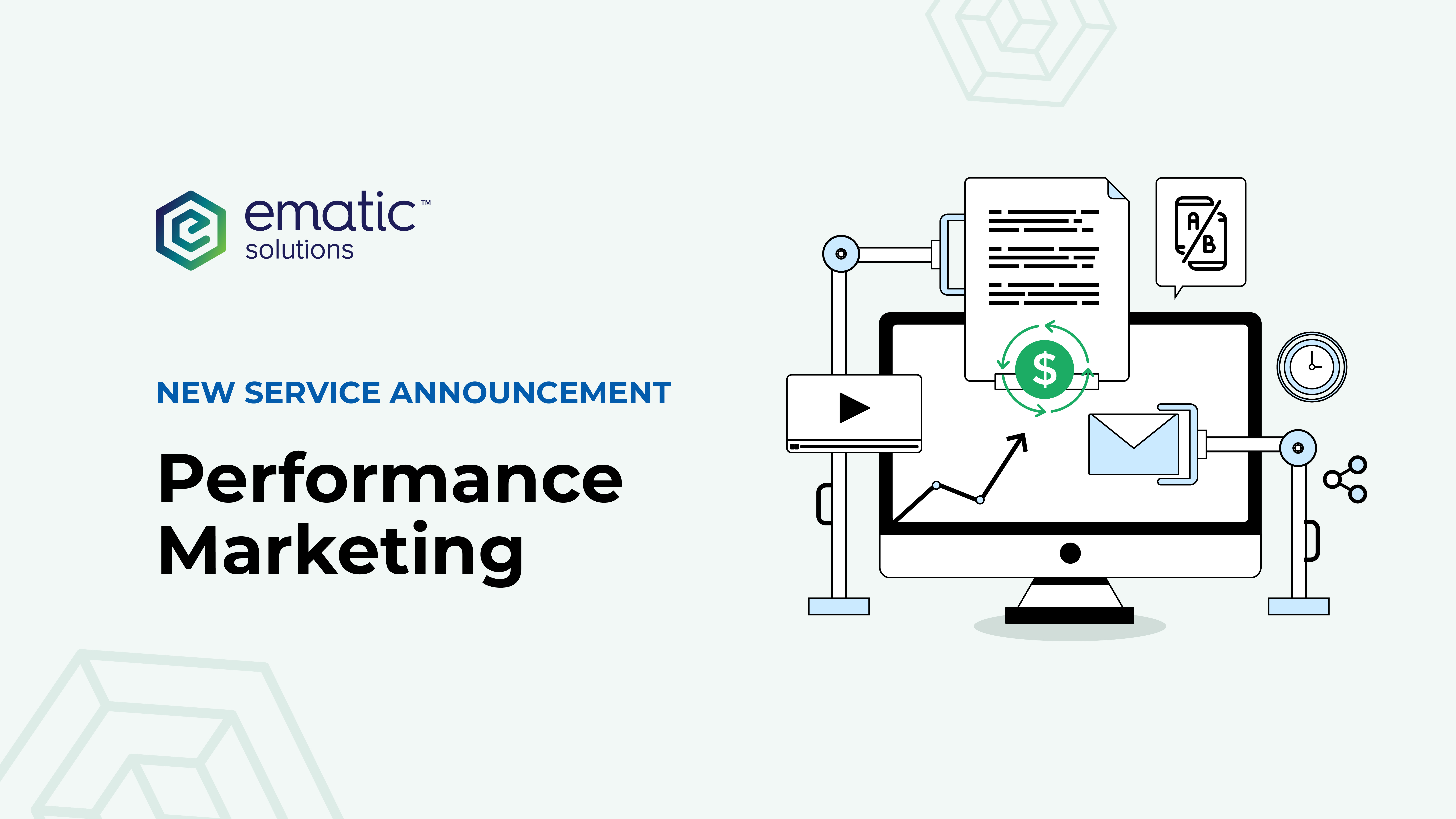
At Ematic we’re a real data-centric agency and we put a huge emphasis on tracking, A/B testing, and analytics. We believe that your data has the potential to be your most valuable marketing resource, and with the right information in hand, we can help you create scalable and repeatable performance marketing campaigns.
CRO: What it is and how to get started

As an ecommerce business, attracting visitors to your website is only part of the job. You also need to help those visitors find what they need, feel confident in their decisions, and complete their purchases. You might already be investing in SEO, paid advertising, social media, and other marketing channels to bring people to your website. But what happens when traffic increases and sales remain the same? The problem may not be how many people visit your website. It could be what happens after they arrive. That is where conversion rate optimization (CRO) comes in. What Is Conversion Rate Optimization (CRO)? Conversion rate optimization, or CRO, is the process of improving a website or app to encourage more visitors to complete a desired action. For an ecommerce business, that action is usually a purchase. For other businesses, it might be submitting an enquiry form, booking a consultation, signing up for a newsletter, or creating an account. The goal is not simply to increase a percentage. It is to understand what customers need, identify what makes it difficult for them to take action, and improve the experience based on evidence. How to Calculate Conversion Rate A basic conversion rate formula is: Conversion rate = (Number of conversions ÷ Number of eligible visits or users) × 100 For example, if 10,000 eligible sessions generate 200 purchases, the session-based purchase conversion rate is 2%. Be consistent about the denominator. A rate calculated using sessions is not the same as one calculated using unique users. In Google Analytics 4 (GA4), for example, you can review both Session key event rate and User key event rate. The appropriate measure depends on the question you are trying to answer and how your key events are configured. Why Does CRO Matter? A website can attract plenty of visitors without turning that traffic into enough sales or enquiries. CRO helps you understand why this happens and where improvements could make a difference. A well-planned CRO strategy can help your business: Understand customer behaviour: Learn what visitors look for, which pages they use, and where they encounter difficulties. Make better use of marketing spend: Improve the experience for visitors you are already investing in attracting. Make the website easier to use: Help customers navigate pages, understand products, and complete important actions. Make decisions based on evidence: Use analytics, customer feedback, and testing rather than relying on assumptions. Improve the customer experience: Reduce unnecessary friction before, during, and after a purchase. CRO should bring together data and an understanding of people. The numbers can show you where a problem might exist, but you still need to understand why it happens before deciding what to change. How to Get Started with Conversion Rate Optimization CRO works best as an ongoing process rather than a one-off website redesign. Instead of changing several elements at once and hoping for better results, follow a structured approach. 1. Gather Data and Understand the Problem Before making changes, find out how visitors currently use your website. Start with quantitative data, which helps you understand what is happening, and qualitative research, which can help explain why. Website analytics and conversion funnels Use Google Analytics 4 (GA4) to examine how visitors move through your website. For an ecommerce business, you might review a journey such as: Product listing → Product detail page → Add to cart → Begin checkout → Purchase Look at how many users reach each step and where the biggest drop-offs occur. GA4’s Funnel Exploration helps you visualise the steps users take to complete a task and identify where they leave the journey. For example, if many users add products to their carts but relatively few complete checkout, investigate the checkout experience before making changes to unrelated pages. You can also compare relevant segments, such as device category, traffic source, landing page, and new versus returning users. A problem affecting mobile users may not be obvious when you look at all visitors together. User experience (UX) reviews Analytics can show where visitors leave, but it may not tell you exactly why. Review your website as a customer would. Can visitors find the main navigation? Are product descriptions clear? Are shipping fees and delivery information easy to find? Is the checkout process straightforward on a mobile phone? A usability review can help identify confusing navigation, unclear calls to action, unnecessary steps, and other barriers that may affect conversions. Customer feedback and user research Customer surveys, support enquiries, usability tests, and feedback from sales teams can reveal issues that analytics alone might miss. For example, visitors may abandon a purchase because delivery costs appear too late in the process, or they may hesitate because product information does not answer their questions. Combine these findings with analytics to build a clearer picture of the problem. Competitor and market research Review how competitors present their products, pricing, delivery policies, returns, and customer reviews. This can help you identify areas where your own website could provide a clearer or more useful experience. Use competitor research to generate ideas, not to assume that what works for another business will automatically work for yours. 2. Form a Clear Hypothesis Once you have gathered your findings, decide what you want to test and why. A useful hypothesis should explain: What problem you identified. What change you plan to make. Why you expect that change to help. Which result you will measure. A simple format is: Based on [what we found], we believe that [proposed change] will improve [desired outcome] because [reason]. For example: Based on our finding that customers struggle to locate delivery information on product pages, we believe displaying delivery details more clearly will increase add-to-cart rates because customers can make more informed purchase decisions. This gives your team a clear reason for running the test and a result to evaluate afterwards. Prioritise ideas based on their potential business impact, the evidence supporting them, the effort required, and the risk involved. A minor design change may be easy to implement, but a checkout issue affecting many customers could
Launching conversion rate optimization (CRO) service

Whether you want to improve marketing efficiency but are at an early stage with CRO or want to go beyond short-term conversion tactics, here’s our new service for you.
Get Shopify via Ematic

With Ematic, we can help you with your full end-to-end setup and maximize the ecosystem of apps that surround Shopify. We not only help you develop or migrate your website, but where we add tremendous value, is leveraging the full Shopify App Marketplace as we have partnerships and experience with all of the best products.